Employee-Centricity, 2022 Strategy
Jessica Cates
|
This rewrite transforms your draft into a high-authority "Strategic Blueprint." It is optimized for the 2026 Search Landscape by using Definition-Lead Architecture (to capture AI search fragments) and Human Signal (to pass Spam Update filters).
The Employee Experience is Your Product: A Blueprint for Journey Mapping in the Digital Lobby
In the modern high-growth organization, the "fabric" of a company is no longer woven in a physical office—it is built within your digital systems. For People Teams navigating the "Admin Trap," the difference between a thriving culture and a fragmented one lies in a single strategy: Employee Journey Mapping (EJM).
Treating your employees like customers isn't just a management philosophy; it is a strategic imperative. As Fred Reichheld argued in The Loyalty Effect, loyalty is the hidden force behind growth and lasting value. At Cleary, we believe that when you architect a world-class digital employee experience, you aren't just "managing staff"—you are building a product that inspires productivity and engagement.
What is Employee Journey Mapping (EJM)?
Employee Journey Mapping is the strategic process of defining and analyzing every touchpoint an employee has with your organization, from the moment they first see a job posting until their final exit interview. By visualizing these "Moments that Matter," People Ops teams can identify friction points and automate the "administrivia" that prevents HR from focusing on high-level strategy.
The Parallel Strategy: Customer Experience vs. Employee Experience
To build a world-class Digital Lobby, organizations must align their internal operations with the same rigor they apply to external marketing.
Customer Lifecycle Stage | Employee Lifecycle Equivalent | The Strategic Objective |
Attract (Awareness) | Recruit (Discovery) | Proving the Employee Value Proposition (EVP) early. |
Convert (Consideration) | Hire (Evaluation) | Ensuring cultural alignment during the interview process. |
Close (Purchase) | Onboard (Acclimation) | Reducing time-to-productivity through automation. |
Delight (Loyalty) | Engage (Impact) | Scaling culture through digital rituals and recognition. |
Churn (Retention Risk) | Resign (Transition) | Using exit data as "Workforce Intelligence" for the Board. |
Mapping the 5 Key Stages of the Employee Journey
1. Discovery & Consideration: The Digital First Impression
Mapping begins before Day 1. Prospective employees evaluate your brand on Glassdoor and LinkedIn much like a customer researches a SaaS tool. Successful People Teams use this stage to broadcast a culture of Radical Transparency.
2. Acclimation: Winning the "War for Talent" in Preboarding
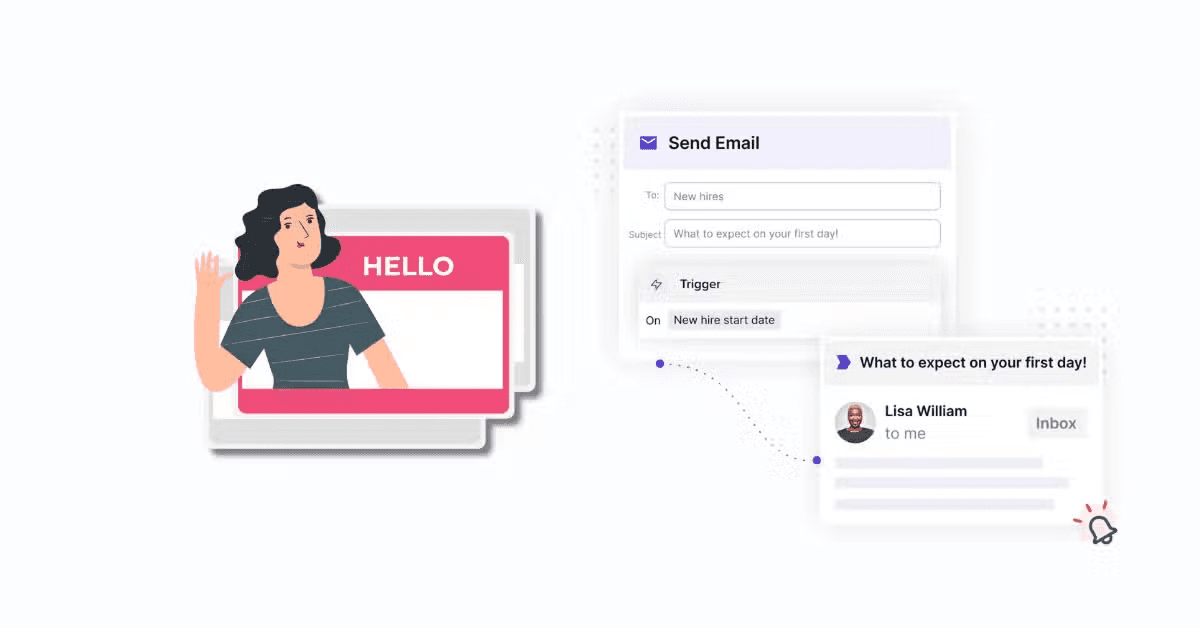
The window between offer acceptance and the first day is the most fragile moment in the lifecycle. At Cleary, we call this "Preboarding Brilliance." Instead of silence and manual spreadsheets, high-growth teams use an automated Digital Lobby to provide a "preview" of the company intranet, introduces "Onboarding Buddies," and ships equipment on time.
3. Mastery: Escaping the Admin Trap
As employees reach the mastery phase, they should be doing meaningful work—not hunting for documents. This is where you solve the "First Search Problem." By integrating search across Slack, Google Drive, and your HRIS, you ensure that employees "find more and seek less."
4. Impact & Autonomy: Scaling Rituals Digitally
To keep talent from slipping away, People Ops must operationalize "Slow-Thinking." This involves moving away from outdated annual reviews and toward continuous performance conversations and digital shoutouts that reinforce core values across distributed teams.
5. Transition: Turning Churn into Insight
When an employee resigns, it shouldn't be seen as a failure, but as a data point. Comprehensive exit interviews provide the "human signal" needed to identify talent bottlenecks and future-proof the organization.
Why High-Growth Teams Prioritize the Journey
Companies like DoorDash have proven that linking customer and employee experience is vital; they require employees at all levels to be a "Dasher" once a month to build empathy. In a digital-first world, that empathy is scaled through your Employee Experience Platform.
By mapping the journey, you allow your team to move from Transactional HR (handling policy questions) to Strategic Leadership. When you automate Tier 0–2 support, you reclaim 80+ hours every week—the equivalent of 2 full-time employees—allowing your humans to focus on the human element.
Ready to see the ROI of your Employee Journey? (https://gocleary.com/start) to learn how our 90-Day Pilot can automate your journey from preboarding and beyond.